
8. Army Presence and Civil Patrols, Guatemala in 1987
“Rio Azul – where the people and the army work together,” the sign said. We were four squeezed into the cab of a cigarette distributor’s truck. My Swiss friend and I were taking advantage of the drive in order to see the villages of Chajul and Cotzal which, together with Nebaj, form the Ixil Triangle, a separate linguistic area, now one of the army’s “Development Poles”. Past the sign and up a hill we stopped in front of a barrier at the entrance to the village. Recognizing the truck with the cigarette logo on the sides, an Ixil man carrying a rifle with a strap over one shoulder raised the barrier for us to pass. Three or four others, similarly armed, looked bored as they sat in a shelter by the road. There wasn’t a soldier in sight.
We drove up to the first little store where cigarettes, soap, candles, soft drinks and other “necessities” were sold. I looked around quickly while the driver and his sidekick did their business. This was a “Model Village” of some sort. My general impression was of gray poverty. Most of the people in this country are poor, and it’s hard to compare poverty with poverty. But the people I saw here looked thinner and sadder, and the houses were drearier and more makeshift, than those in the long settled villages nearby.
We squeezed back into the truck and bounced along to the next store. A surprising number of cigarettes were sold for the amount of cash these people must have. There are no jobs here, the army limits the amount of land they can sow, and civil patrol duty takes up a lot of time. You don’t have to buy a whole pack of cigarettes here; you can pay for two at a time. I guess that makes it easier to smoke if you are poor.
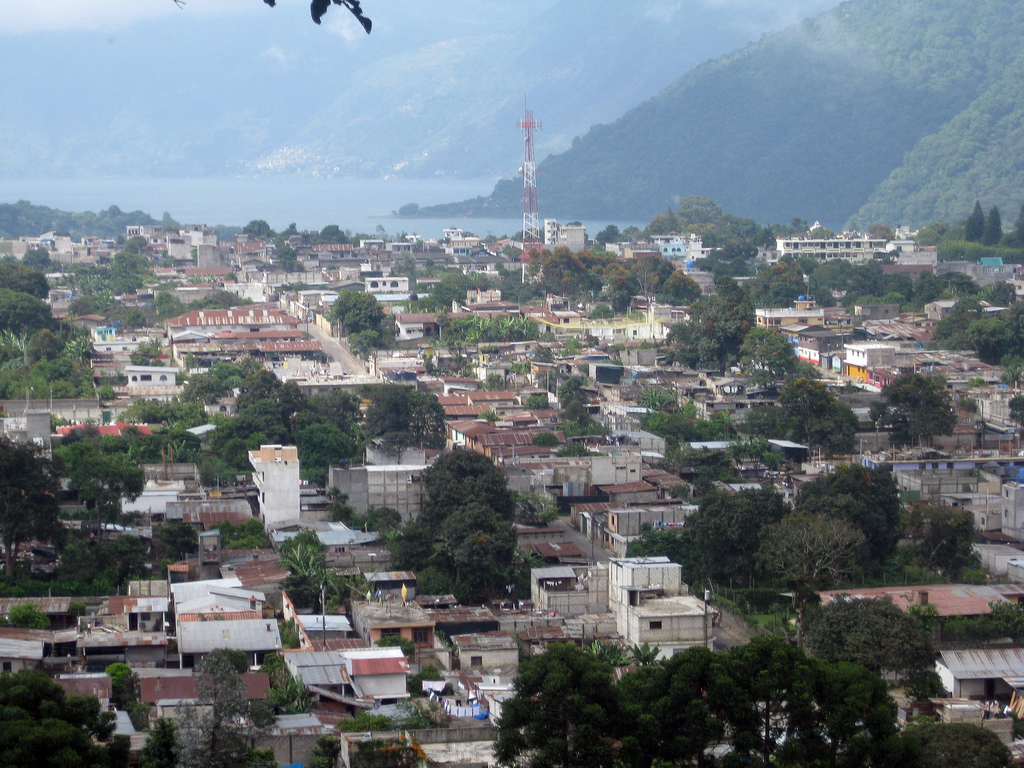
View of town on lake
There are no civil patrols anymore in San Lucas Tolimán, a town on the shores of Lake Atitlán. A San Lucas man explained to me that because of the large population, they used to only work a half-night shift once a month. He hated it, hated carrying a gun, but it was a legal obligation to go. They never encountered guerrillas. San Lucas had not been the scene of much revolutionary activity all along. By his count there were “only” twelve disappearances during what people here refer to as “the violence” of 1979-84. So when the civilian President Cerezo took office a year and a half ago, some men of San Lucas took him up on his promise to end the civil patrols. “We’ll hold you personally responsible if the guerrillas attack,” warned the army. And there have been no problems to date.
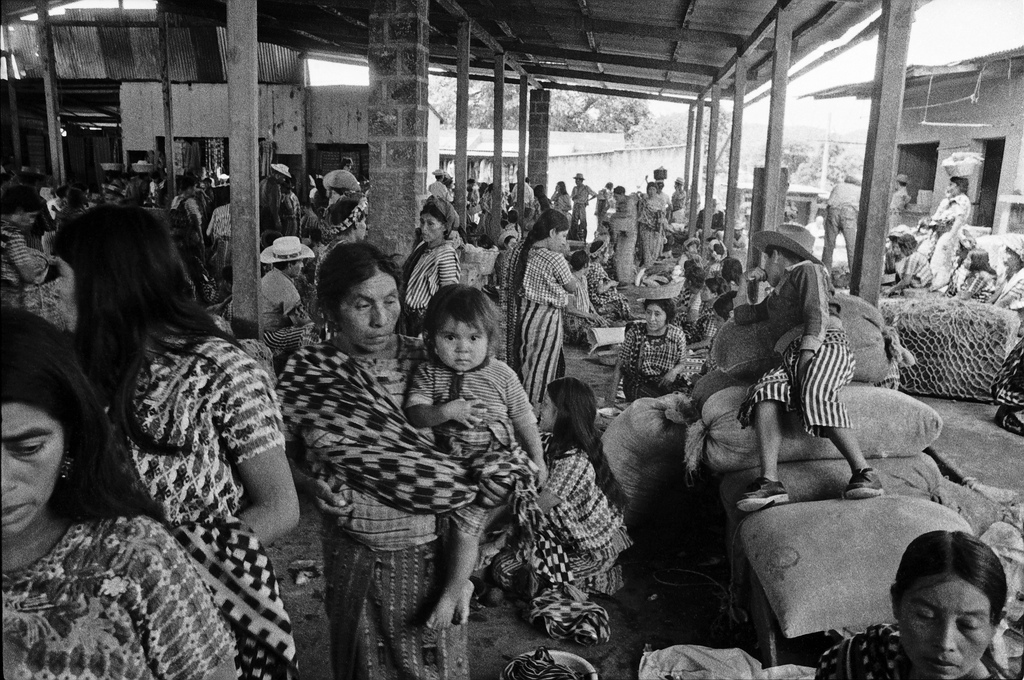
Santiago Atitlàn market in 1976. Photo by Flickr user majunznk.
Neither are there civil patrols an hour away – and a language and culture away – in Santiago Atitlán, and not because it is quiet. Now and again there is a skirmish, or an attack on the army base just outside town. The day I arrived, two gringos I met had seen a soldier, bleeding profusely from the groin area, being carried by two other soldiers to the health centre. My friends could not tell if he was dead or alive. His bearers were wild-eyed, scared to death themselves, as if they were walking through an unknown jungle rather than a town full of people. As they passed, a small boy said, “Ahora el cazador es cazado.” “Now the hunter is being hunted.”
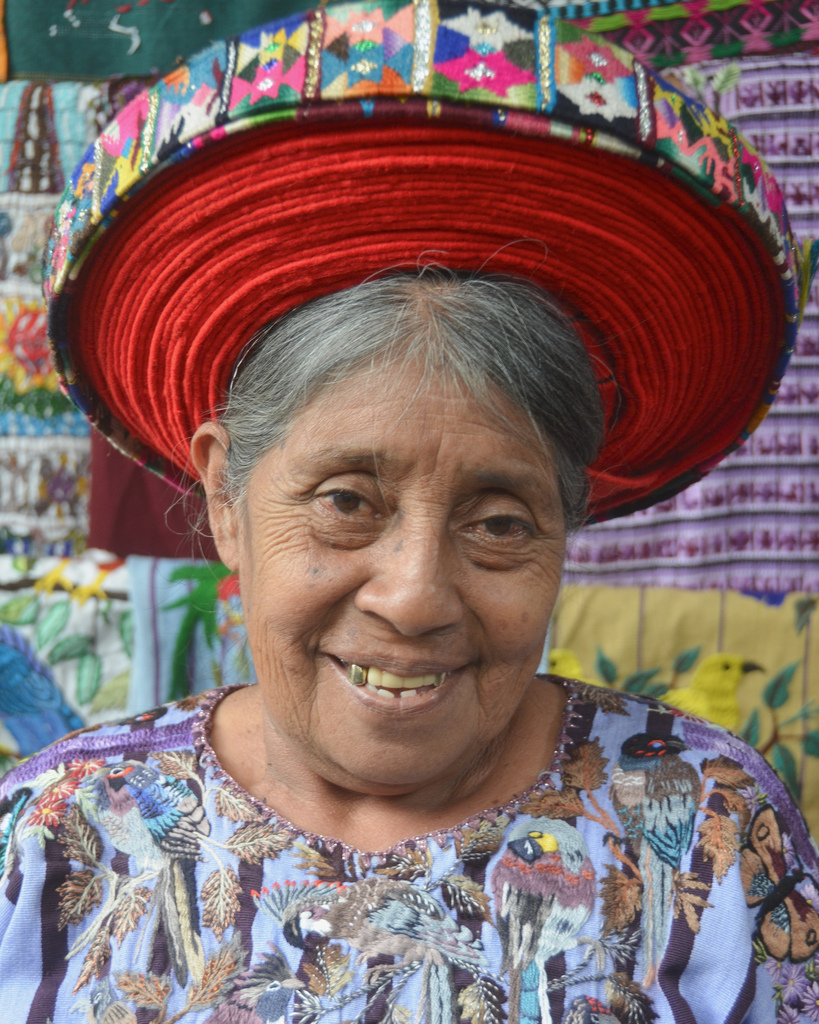
Santiago Atitlan woman in traditional headdress and elaborately embroidered huipil
It is a resistant town, conservative of its customs and language, one of the few places in Guatemala where the men still wear their traditional dress. One rumour I heard was that the guerrilla group was targeting the town’s orejas or “ears” – the people who had fingered the “subversives” to the death squads. Few people spoke enough Spanish to have a conversation, and those who knew what was going on weren’t about to talk to me. In the Catholic church there is a memorial plaque to the priest, an American who was killed during “the violence”. Now the evangelical churches are very visible – and audible in the evenings, preaching salvation from communism as well as from sin.
You get a very different impression of the situation in Guatemala depending where you are (and whom you talk to). At the border, around Lake Atitlán, and around Antigua, all heavily touristed places, and in Guatemala City, I hardly ever saw a soldier, except in the banks or at the army base on the outskirts of Santiago Atitlán. There are lots of National Police around the city, but they feel less threatening than soldiers; they’ve had public relations courses.
An exception was the National Day parade in the capital. Marching platoons of indigenous soldiers in battle fatigues were preceded by the cadets of the military colleges, tall and fair-skinned in flashy red or gray dress uniforms, passing in perfectly machined synchrony – future officers of the men they were symbolically leading. (A boy can expect to be conscripted anytime from age 14 for a 2 1/2 year term. Somehow the rich kids often get out of it.)
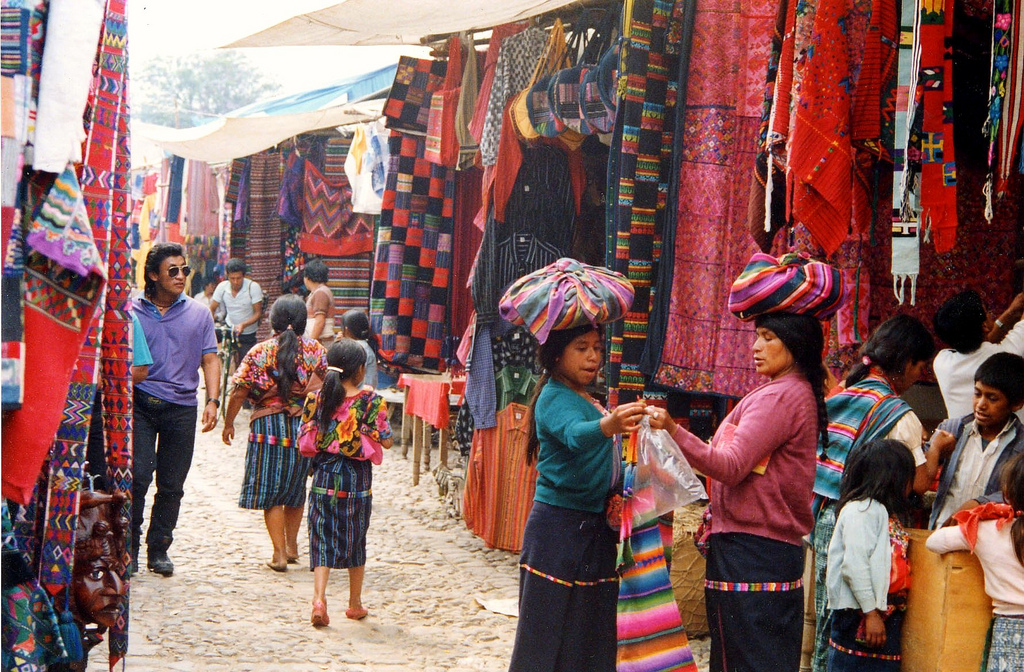
Market in Chichicastenango. Photo by JD Lasica, Flickr
Then I headed north into El Quiche, where there had been a strong revolutionary movement. I was taking an early morning walk through Chichicastenango when I looked up – and there in the middle of town was a guard post, two soldiers with their guns sticking out over the street.
An hour north, in Santa Cruz de Quiche, there is a large military base outside the town and I saw soldiers posted near the market. Five hours further north, Nebaj’s main square by contrast looked like an army camp. Soldiers were on duty in guard posts at various street corners while others were eating and hanging out. A couple of times I noted officer types chatting with local people as if it were a PR exercise. Passing by the square one night I stopped to see what was going on. Two soldiers were singing a popular ranchero song into a microphone in untuned harmony, while guitars strummed along and a few dozen civilians and military crowded around to hear.
The civil patrols, in which all men from age 16 up must participate, are not only the front line against guerrilla attack, their existence is a tool of control over the activities and movement of the population, and an inexpensive way for the army to get the people to police themselves. They also spread ideas, such as the notion that Nicaragua is a God-loathing, family-hating, loveless quagmire of evil, which I learned from a loudspeaker in the main square of Nebaj.