
7. Lost Village, Ixil Triangle, El Quiche, Guatemala, 1987
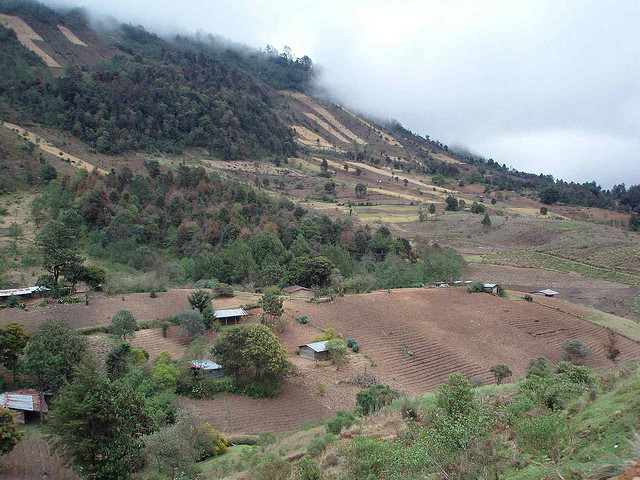
Subsistence farm plots on very steep slopes. This isn’t sustainable and causes erosion, but wealthier people have taken the better lands. Photo by Flickr user Lon&Queta.
My horse managed the last switchback of the steep narrow rocky trail, and stopped to look at the view – or to let me look while his black sides heaved in and out. Below us was a valley in the Cuchumatanes, protected by its green mountains from approach by motor vehicle. Like a soft carpet on the floor and halfway up the walls of the valley, until the slopes were too rocky and steep to hold the roots, stretched acres and acres of milpa, or cornfields. About four or five clay-tiled rooftops could be seen, almost buried in the corn.
“That’s Cocop,” said the guide. “Very few people here; this is dangerous. The guerrillas like this kind of place.” I got the feeling that he was trying to scare us off so we’d turn back. It had been a two-and-a-half hour ride from Nebaj, mostly uphill, and his horse was not very strong and took a lot of persuasion. And he later told us he’d been up all night doing his weekly 24-hour Civil Defense Patrol shift. But this was what I and my companion, a Swiss woman about my age, had come to see.
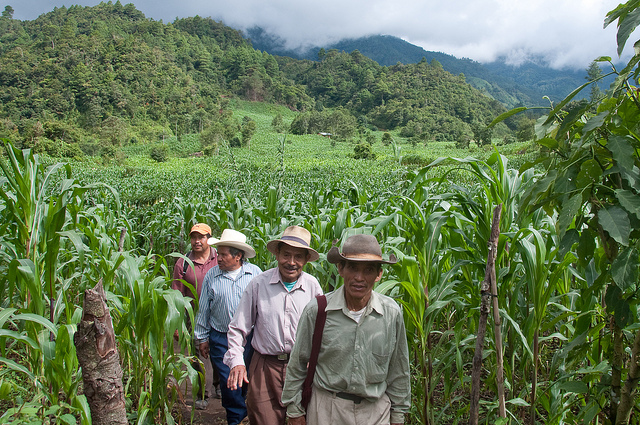
Local men walking through cornfields. Photo by Flickr user orionlee.
We headed down the mountain trail slowly. From the edge of the milpa down, it was a losing battle to keep the hungry horses from tearing up cornstalks and eating them. We stepped aside for a man on horseback, another man on foot leading an ox, and two women in the elegant red and white clothes of Nebaj. They were coming from a village two hours walk further on, and heading for Nebaj. At the bottom of the hill we tied the horses in the shade and set off to explore Cocop.
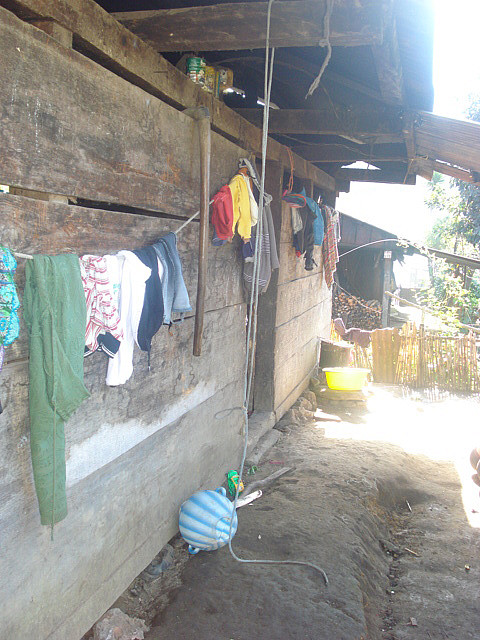
Typical house exterior in the Ixil Triangle. Photo by Flickr user Renata Avila.
Fuschia, bougainvilleas and white lilies seemed out of place in this quiet, overgrown landscape. They grew along a path which led us past a babbling brook almost hidden by the vegetation over it, a large grassy clearing shaded by tall trees, a space with flowers that looked like it had been someone’s front yard. No people. We waded through tangled vines and corn to one of the few houses standing. Clay tiles were still lying in orderly rows on the roof, but the sky shone through here and there. The one room was empty – a few old boards, broken pottery, nothing more. A black spot on one wall showed where a cooking fire had been. The steam bath outside was overgrown and in ruins. Children’s drawings decorated the outside wall. Ashes showed that someone had recently made a small fire in front of the house.
Continuing along the path we met a (peasant) working in the milpa. He was friendly and jovial, in the manner of the Ixils. He lived in Nebaj and came here to plant milpa and keep a few cattle. Sometimes he would bring his young son along. The army passed through once in a while on their way to the next village. “Is it dangerous?” we asked, “Are there traps?” “No, no. It’s very quiet and beautiful here.” And it was.
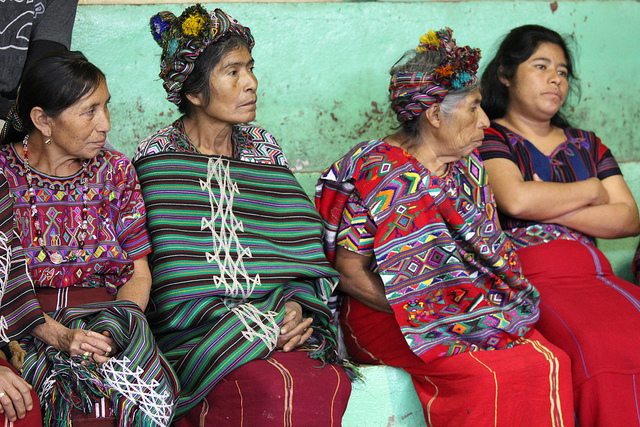
Ixil women in 2013, listening to a Human Rights Commission meeting about the genocide. Photo by Flickr user Comisión Interamericana de Derechos Humanos
On the way back I asked the guide a few questions. In 1980, Cocop was a village of about 400 people. There was even a school. Then there were killings. The survivors now live in Nebaj. Cocop was one of the 440 villages wiped off the map by the army in an attempt to neutralize civilian support for the guerrillas and bring the population “under control.”
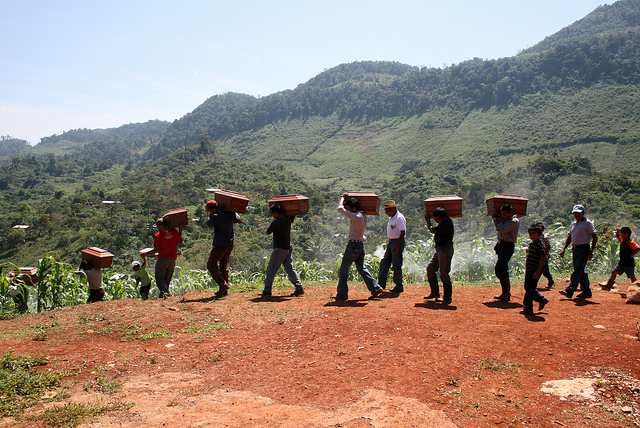
Carrying remains of loved ones after exhumation, perhaps in Cocop. Photo by Flickr user Trocaire.
2013 UPDATE:
In the 90s, with the permission of the army, some families started returning to the Cocop, but life there is still difficult. Bodies from the massacre have been exhumed. (Link to YouTube video in Spanish about the genocide in Cocop and life there today)
During a visit to Central America, on March 10, 1999, President Bill Clinton apologized for the past U.S. support of right-wing regimes in Guatemala. “For the United States, it is important that I state clearly that support for military forces and intelligence units which engaged in violence and widespread repression was wrong, and the United States must not repeat that mistake,” Clinton said. (Source: Robert Parry)
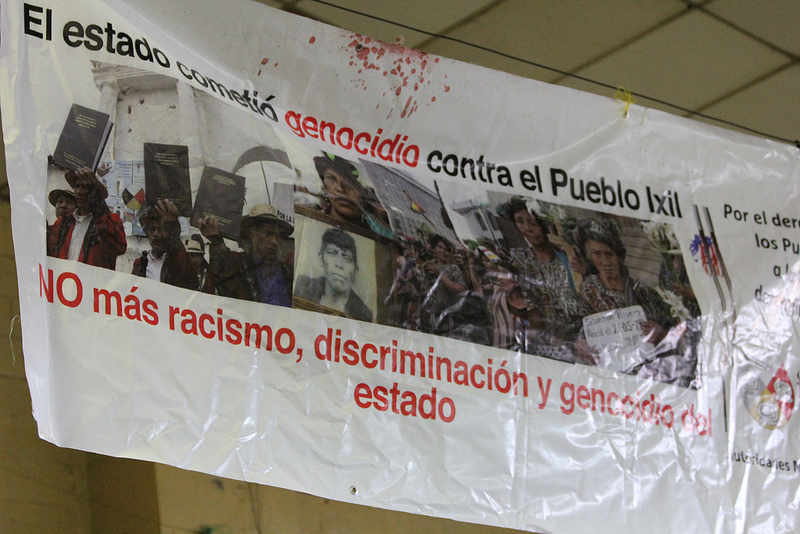
The banner reads: The State committed genocide against the Ixil people. No more racism, discrimination and state genocide. Photo by Flickr user Comisión Interamericana de Derechos Humanos
More recent, disturbing reportage here: http://www.democracynow.org/2013/4/19/exclusive_allan_nairn_exposes_role_of