
6. Momostenango, Guatemala, 1987
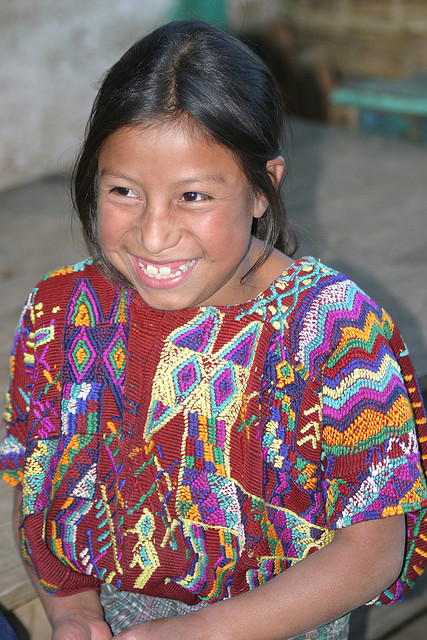
Girl in Momostenango wearing traditional huipil. DavidDennisPhotos.com
First impressions of Guatemala: You go through the border, trying not to pay more money than necessary to the various officials, who have many tricks to make you pay, and climb into the bus. Then the movie starts: the hills are higher and steeper than in Mexico, and corn is growing in rows on amazingly steep slopes. The costume department has gone wild: the Mayan women in particular all wear traditional dress which differs from one area to another.
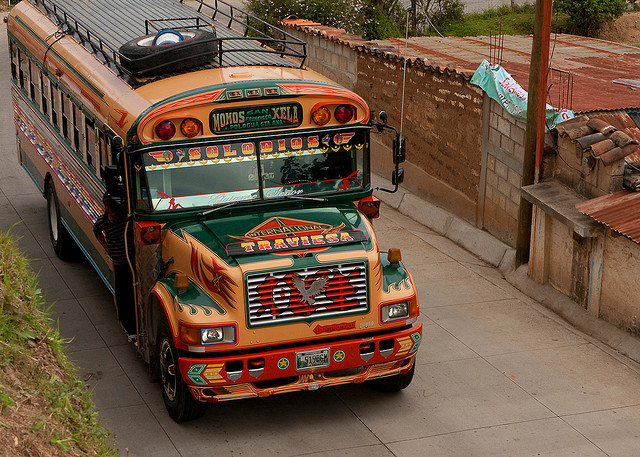
Public transport in Momostenango. Photo by DavidDennisPhotos.com
The only people crossing the border were foreign, but we did not have the bus to ourselves for long. In the converted schoolbuses used for transportation in Guatemala, people sit three to a seat, just as we used to as kids. It doesn’t matter if you are twice as big as the average Guatemalan; the driver needs to fill the bus to its legal limit, so you get close to people very soon.
When I got out to change buses, it seemed I was on the top of the world, looking down into a distant valley with a sprawling town below. I finally got a ride to Momostenango in the back of a pickup carrying an engine tied down with stout ropes, and assorted people, both ladinos (people of mixed race) and indigenas (Mayan Indians) distributed around it. Sitting on my sleeping bag gave me the best seat, and I appreciated it very much as long as I could stay on it; the road was so rough I had to hold myself down as my brains got jiggled into jelly.

Momostenango. Photo by Eric Walter
The closer I got to Momostenango, the better I understood why my friend Paul from Montreal was still there after nine months: hills of pine trees, brick tile-roofed whitewashed houses almost buried in the corn growing around them, friendly people, indigena women in brightly embroidered blouses (huipiles) and woven shawls, cobblestone small towns surrounded by hills, Mayan altars, limestone formations, and interminable milpas (cornfields) everywhere, even in the town, wherever there was a spare patch of land.
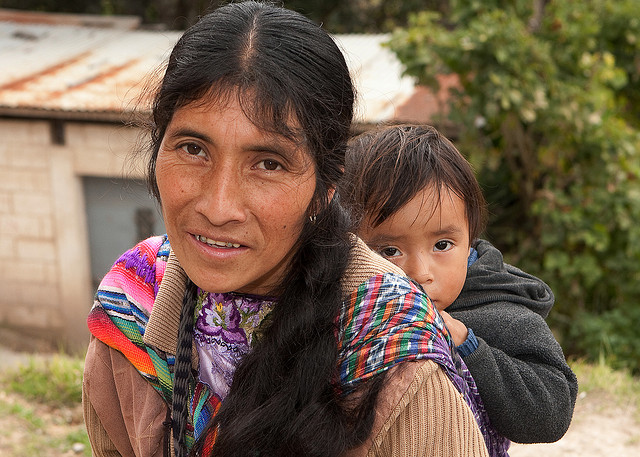
Photo by DavidDennisPhotos.com
On my first day in Momostenango, walking outside the town, Paul and I met the mother of one of his students at the parish school. Norma, she told us, had stayed home from school because her foot was sore from a nail in her shoe. She led us to her house. After two weeks of infection, the 9-year-old’s foot was swollen up, the wound oozing blood and pus. Urging the family to take her to the clinic, we learned that there was no one who could take her there. We volunteered to come early the next morning and carry her the 2 km into the clinic operated once a week by some Canadian nuns.
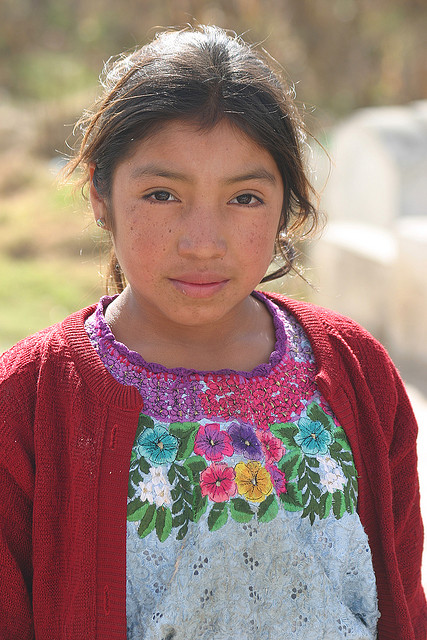
Momostenango girl. DavidDennisPhotos.com
Antiseptic is not a known thing that people keep in their homes. There is a fatalism that says if you get sick, it is God’s will. The cost of seeing a doctor (2-5 Quetzales, or $1-2) and the medicine he will prescribe is far beyond the means of campesinos (peasants) subsisting on their own harvests with very little money passing through their hands. The government-run Health Centre gives medicine free, but doesn’t have the quantity or variety it needs. A friend of Paul told us that pharmacists will move their oldest stock, often out of date, first. There might be fewer pills in the box than specified on the outside. He also told us about the four injections, each costing Q12, needed by his wife after a miscarriage, and the incredible burden the expense was. Norma’s grandfather, we learned, has had diarrhoea for years, but won’t go to see the doctor; he’ll die first. He can’t afford the medicine anyway, so why should he go, even though he can’t do much work?
We did carry Norma to the clinic and then to the Health Centre for a tetanus shot, which was free. There, her grandmother who accompanied us received a sharp lecture on the theme of “Why didn’t you bring her here earlier?” from a nurse. That surely didn’t encourage future visits.
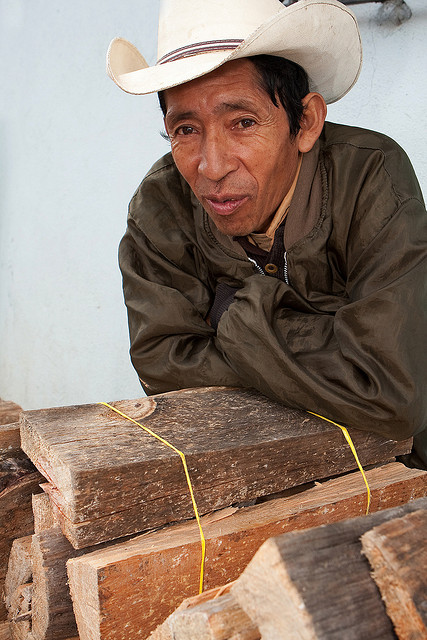
Man selling firewood in Momostenango. DavidDennisPhoto.com
It is relevant that the nurse was ladina (mixed race, not part of the Mayan culture) and the grandmother indigena, since the common wisdom is that the indigenas are dumb and stupid, as one intelligent and earnest indigena man told me. Another told me that he grew up believing that only ladinos could learn to read, write, do arithmetic, and organize things. They were the only ones he ever saw doing these things, or who had had the opportunity to learn.
Happily, we saw Norma in the market three days later, with her grandmother. The girl had socks and shoes on, and was walking fine. The nuns had given them antiseptic, gauze and cotton, penicillin, vitamin tonic, and some old nylon stockings to hold the bandage on. The grandmother was now practically a nurse, I teased her.

Girl with her grandmother. Photo by DavidDennisPhotos.com
We were particularly glad to have had the grandmother with us because there is a rampant paranoia that white people steal children. Much is rumour, but the fact remains that there is a market for cute Guatemalan babies. Mothers with small kids on their backs pass you on the far side of the road while everyone else is friendly and all smiles.
Given their history of exploitation by Europeans and their resistance to losing their identity by holding fast to their culture, you can understand the Mayans’ suspicion about western medicine. But sometimes the result is sad. Many, many kids don’t get their vaccinations. Parents hear stories that fuel their fear that the clinic staff here don’t know how to give the needle properly or will give three at once (a normal procedure) making the child sick with a fever (also normal). The story grows: the child was very sick or died (very, very rare, but it can happen). Or that women are being sterilized by injection without knowing it. (Depo-provera, an injectable contraceptive, has been used on women without their knowledge; its effects are temporary but a possible rare side effect is sterility.) Campaigns to vaccinate everybody without adequate explanation breed suspicion. Well-meaning efforts can go so wrong.
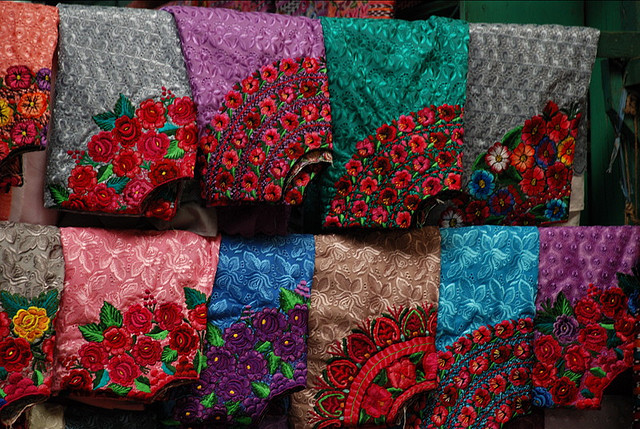
Embroidered huipiles (women’s blouses) in the Momostenango market. Photo by Whirling Phoenix, Flickr.
How careful and slow, thoughtful and communicative, one’s work has to be to have a positive effect. There is such a need for good health education, and if people can realize control over their own health, will they not feel more able to direct other aspects of their lives?
All photos on this page are from Flickr and are under a Creative Commons license.