
11. Keeping Homefires Burning in Santiago Atitlán, 1987
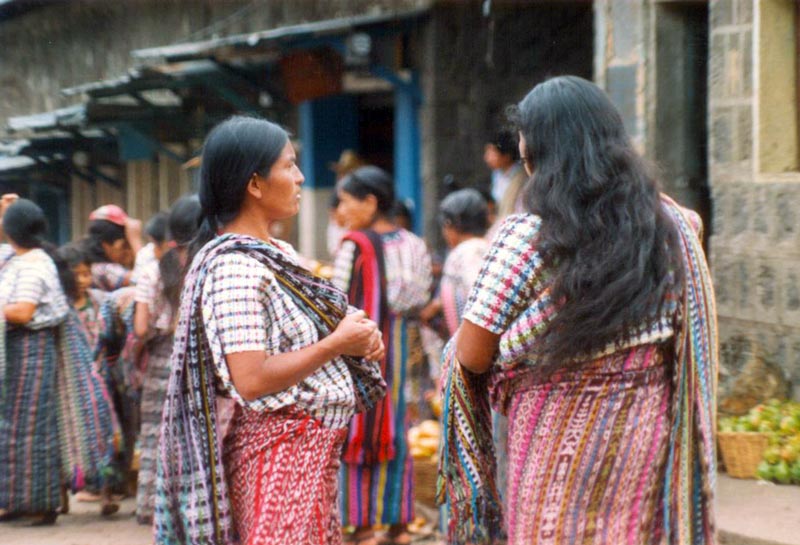
Women in the traditional dress of Santiago Atitlan. Photo by Flickr user tryangulation.
In Santiago Atitlán I stayed in a little house loaned to me by its tenant, a young American, while he was away. The house had one room, two wooden sleeping platforms with straw mats for “comfort”, a table and chair, two large rats, a little porch with an old hammock, an outhouse, and a magnificent view of an extinct volcano whose slopes are partially cultivated, and the harbour, where the men of Atitlán come and go in their dugout boats, paddling standing up. (I tried this, and found it to be a cross between canoeing and skiing, so I managed quite well I thought, hardy Canadian that I am.)
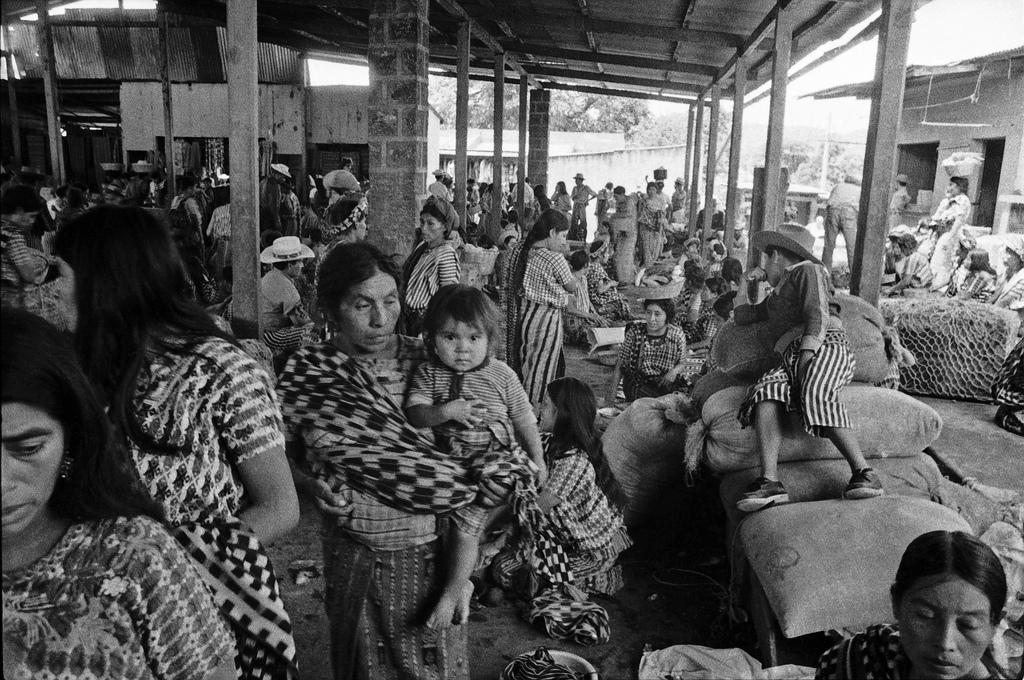
Market in Santiago Atitlan, 1976. Photo by Flickr user majunznk.
I also had a kitchen – a space enclosed by cornstalks furnished with a metal grid for putting pots on and a fire under. “Great,” I thought, “I’ll boil some water so I can save my iodine tablets and my liver too.” So I went to the market and bought a small clay pot (32¢) and some fagotas – pieces of resin-soaked pine which you can light with a match (2 for 3¢). I gathered some firewood from around the yard, put some water in the pot, lit my fagota, got the fire going, put the pot on – and it was dripping so badly it put out the fire.
“Your pot is no good,” said the landlady. “Go back and exchange it.” I returned to the market and got some local women to help me pick a good one. The landlady took a bit of cement, mixed it with water, and rubbed the bottom and sides with it. Then she burned the pot in the fire until it was black all over.
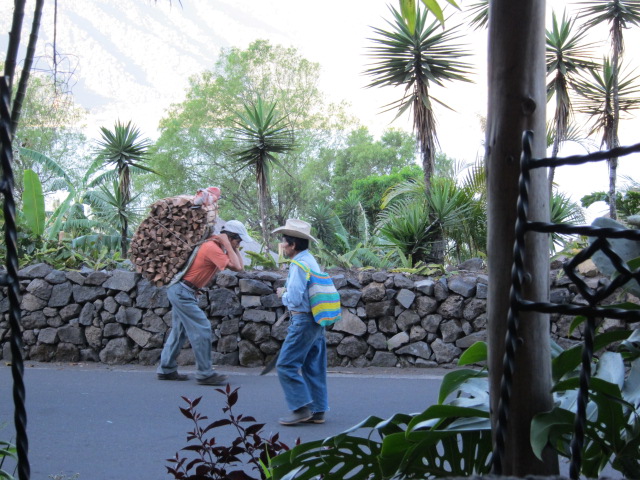
Man carrying large load of firewood
“Now it will hold water.” She was right, and I set about to keep the fire going. But despite my theoretical knowledge of thermodynamics, I wasn’t sure how to keep a fire hot long enough to boil water. While figuring it out, I thought about the men I’d seen everywhere, carrying on their backs huge loads of firewood that would only last a family a day or two. I thought of the expense for poor families who have to buy firewood, and the utter dependence in some “model villages” on the army which has a monopoly on the supply of this absolute essential. And the forests are disappearing.
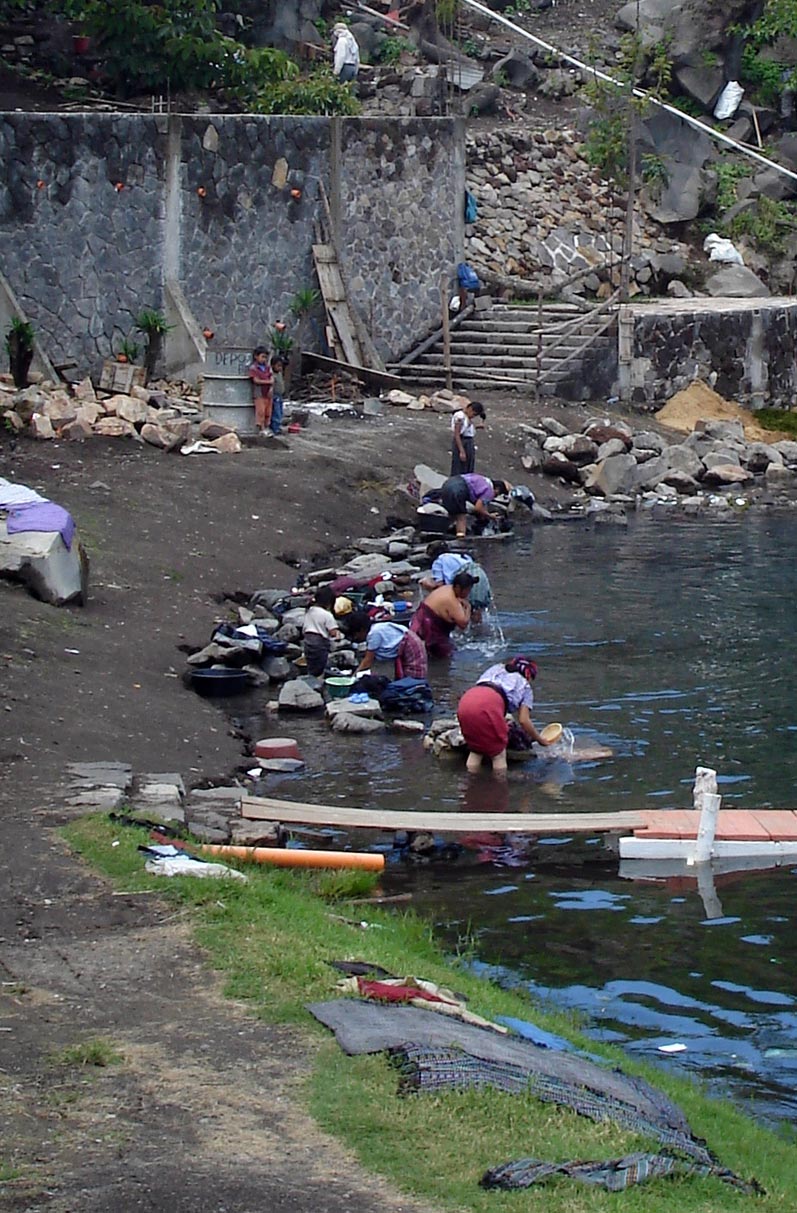
Washing clothes in Santiago Atitlan, another time-consuming job. Photo by Mike Fox, Flickr.
I also learned that “keeping the homefires burning” takes a lot of time and attention. I ended up with a plateful of boiled potatoes and greens, a litre of smoke flavoured water, smoke in my hair and eyes, and a lot of appreciation for the women who cook like this every day.