
29. Revisiting Guatemala 1988
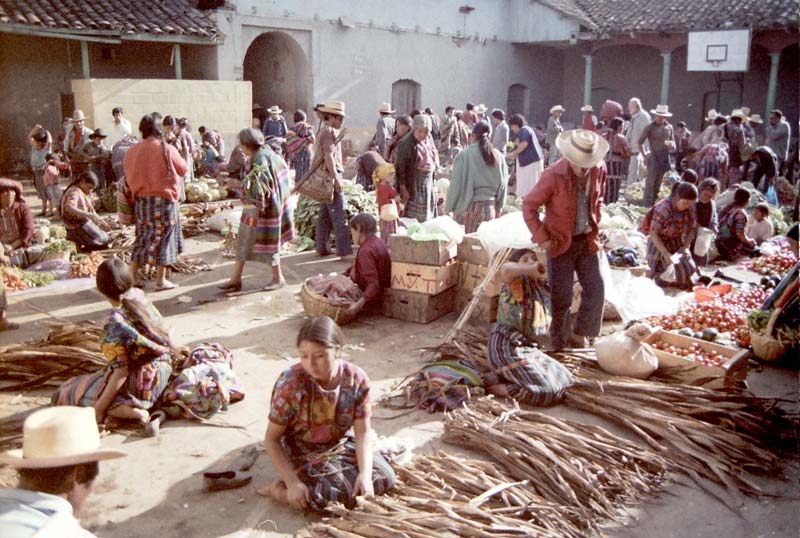
I feel a little worried about the cold snap in Guatemala. Twenty-one homeless people have frozen to death in the Guatemala City, and I’m slightly concerned that my blood, thinned by Managua’s heat, may make me another victim.
From the plane I see volcanoes rising out of the land, then Lake Amatitlan. I remember that I’ve been on top of a couple of those volcanoes, and Guatemala’s charm returns to enchant me. I also see the city sprawled over the valley, rended by steeply banked gullies, and houses set right to the edges. Many people have died, and many more have lost their homes, when their shacks slid down the eroded banks.
It is Sunday, and the main shopping street is packed with people in their best clothes. Many are young women in traditional dress and new high-heeled shoes. They’re probably domestic workers on their one afternoon off per week.
Some shops are open and the cinemas are packed. I buy some new clothes. Except for my Christmas T-shirt, I’ve been wearing the same few items for several months. In Nicaragua where so little was available to anyone, I felt most comfortable dressing plainly and drably. Now in Guatemala, I adjust more happily this time to commercialism, and turn into a bourgeois peacock. I enjoy it, despite knowing that many of the people I pass on the street get something new to wear once a year, maybe.
The politeness of Guatemalans strikes me once again. I comment on this to an older gentleman in the craft market, and he speaks of his country as if it were a last bastion of civilization. Nicaraguans are a lot more direct and brusque.
But in Guatemala, one is always much more the stranger. On the surface all is smiles and friendliness, but the soul stays hidden, an expression of the differences between us, of the resistance of the indigenous people to losing their culture to centuries of domination, and of the lack of freedom of expression.
You also encounter in Guatemala a profound unawareness of the outside world.
“Where are you from? . . . Canada, is that far?”
“It’s not part of Guatemala.”
“Oh! Didn’t you bring your mother and father with you?”
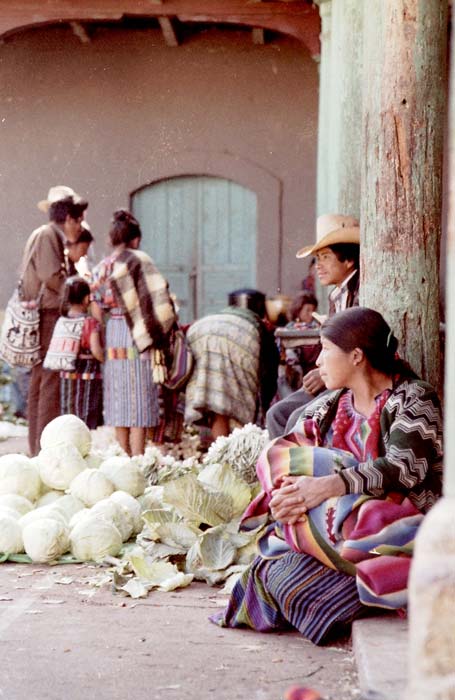
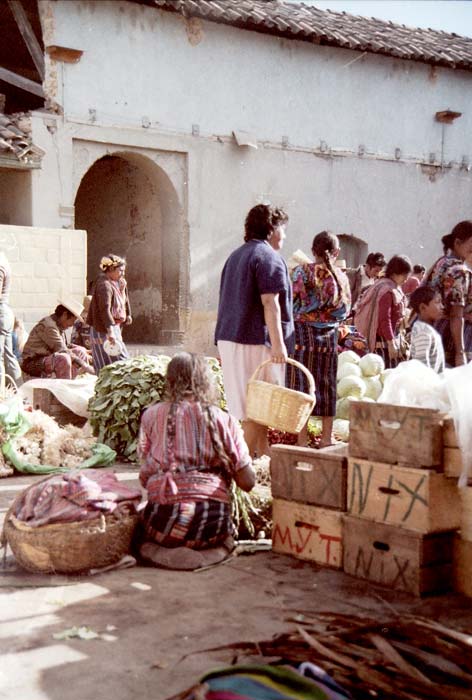
After three days in Guatemala City, I go to the big indigenous market in Chichicastenango to be a tourist: that is to buy things and take pictures. It is a truly impressive market. Twice a week this sleepy town fills with traders from all over the country. They start setting up the night before, filling the square with covered booths and incredible merchandise.
The outer circle of stalls and some of the side streets are for the tourists: second hand huipiles (women’s embroidered blouses), wall hangings, wooden masks, and various funky confections designed for people like me. The inside circles are for the locals: foodstuffs, batteries, yarn, soap, and new huipiles.
I leave Chichicastenango at 7 a.m. on February 5, having failed to locate a newspaper and still not knowing the result of the U.S. Congress vote on Contra support two days before. Most of the Guatemalan population is illiterate and hardly even speaks Spanish, so newspapers are scarce.
I finally buy one through the bus window from a hawker and read the reaction to the news of the Reagan proposal’s rejection. This was a much-anticipated event in Nicaragua, and I wonder whether I should have stayed in Managua another few days. Here I am alone, having no one with whom to celebrate or mull over the future, and I laugh inwardly as I read a columnist’s attack on the 219 stupid asshole congressmen who sold Central America and their own country’s interests to communist expansion.
The Guatemalan countryside, green and lush when I was here four months ago, with corn growing as high as the eaves of the houses, is brown. The milpas (plots of corn) are either cleared and empty, strewn with dry cornstalks, or have rows and rows of dry stalks bent over at the top to let the corn ears hang downwards.
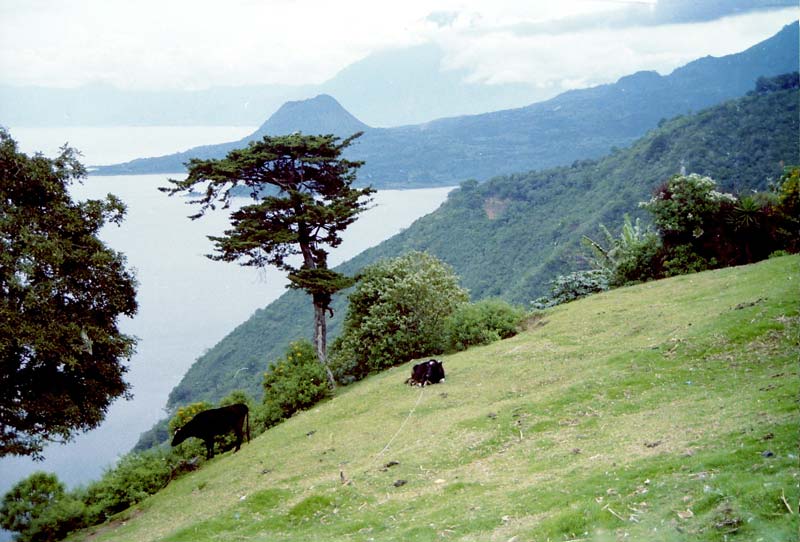
I realize how overused the land is, compared to Nicaragua. Miles of rounded hills are completely naked of trees, the light brown soil exposed even on the steepest slopes. I imagine the erosion and the campesinos who have to work this difficult land to survive.
It is forbidden to stand up in busses in Guatemala. So there is a perpetual charade in which all participate. When the bus is about to pass a police post, the conductor motions everybody who does not fit into the seats to crouch down in the aisles, pretending to sit. This cooperation against authority still makes me think of the people’s resistance to oppression that the peasant organizations boast about. Hanging on to their culture, language and dress is an active refusal to bow to the dominant class.