
27. Dental brushes with power, Nicaragua 1987
Before I left Nicaragua, I had some dental work done. I guess I picked the right dentist.
“Do you know who that was?” he asked, referring to the patient before me. “That’s the wife of Jaime Wheelock,” (one of the nine members of the FSLN Directorate, and Minister of Agriculture).
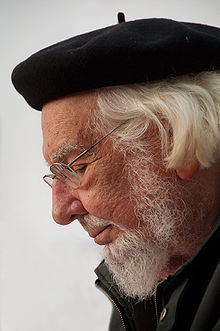
Ernesto Cardenal in 2009. Photo by Roman Bonnefoy
That day he was laboriously fitting me with a crown. Eventually, the next patient came in and asked if he should come back another day. It was Ernesto Cardenal, priest, one of Latin America’s most famous poets, and Minister of Culture. I was starstruck.
“No, no,” said the dentist, and at that moment he dropped the crown. “We’re finished here. Just help me look for her tooth.” Ernesto got down on his hands and knees to help look for my tooth.
The next patient after Ernesto was to be Humberto Ortega, Defense Minister, but I didn’t have time to wait around to see him.
I felt reluctant to be leaving Nicaragua, even though life was getting harder there, with worsening gasoline shortages, electricity rationing, soaring prices, and the hot, hot weather coming on. There were still a lot of places I wanted to see.
It was exciting watching war and peace unfold from that vantage point, and I was learning so much. Nicaragua was breaking unspoken rules that were familiar enough in Canada: the rules of class structure, hierarchy and upward mobility, dress and manners. The change is partly due to poverty, but has more to do with the ideals and the fact of the revolution as well as with the flight of much of the owning class, the bourgeoisie.
“The parties, the clubs,” bemoaned an elderly American woman who had married another Nicaraguan dentist fifty years ago. “Now all the blue-eyed, fair-haired people are in New York and Chicago and Miami and Los Angeles. There’s nothing of Society left . . . . These people running the country now, their families never had anything, they were really poor people . . . well, Jaime Wheelock’s family was well known, but the rest – what do they know about running things? . . . Don’t let those Internationalists fool you. Somoza was a good man, he gave his people everything, he was good to them. Yes, he had his hand in the till, but he loved his people. . . .”