
2. Crossing into Mexico, visiting Veracruz, 1987
I knew I was in Mexico the minute I crossed the border. It was as if the U.S. had dug this river, the Rio Grande, to keep the Third World out. Paint and plaster peeled off the walls of the immigration offices. The people working there seemed to be less organized than the Americans on the other side of the river. They made a show of knowing what was going on, however, which cast me as the confused one.
The moment the bus swung into the street, I knew it was the Third World by the number of people in the street, the smells and the sounds. As in Africa, there were many houses in a permanent state of partial completion, their upstairs unfinished and open to the sky, piles of concrete blocks and steel reinforcements sticking into the air, awaiting the time when the owners might accumulate a little more cash. In rich countries, there is capital available which enables us to build to completion immediately – for the price of being tied to a long mortgage.
I took an overnight bus to Mexico City where I met my friend J. After two days of rest and recovery from adaptation to the altitude which left me tired and a bit headachy, we shouldered our daypacks and headed here to the Gulf Coast for a ten day trip.
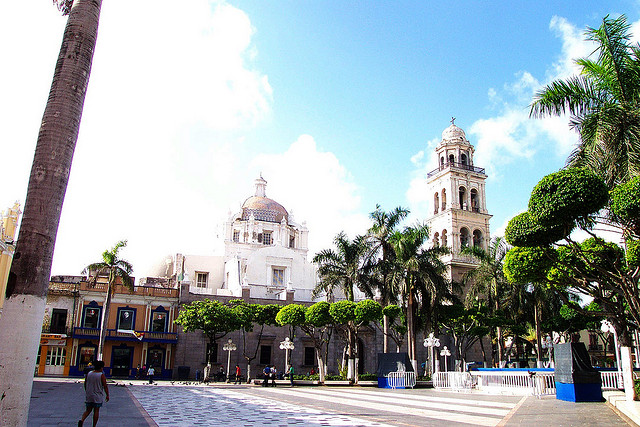
Veracruz. Photo by Russ Bowling, Flickr
Veracruz, seven hours from Mexico City, is the country’s main seaport. Tourists, mostly Mexican, are entertained by huge oil tankers and other ships, a container port, impressive dry dock facilities and old castle ruins.
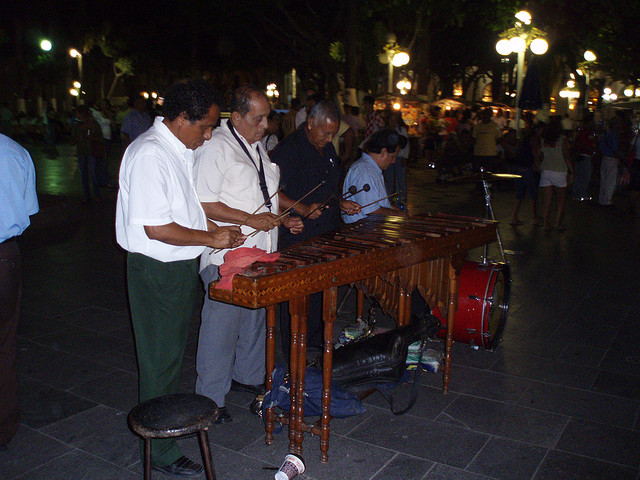
Marimba band in Veracruz. Photo by Francisco Guevara, Flickr
The most bizarre and fun feature of Veracruz is the live music, which is all over the place. In the beautiful Zocalo, or main square, with its fountain, palm trees, and sidewalk restaurants on two sides, we saw — and heard! — up to three marimba bands at once, all within earshot of each other, competing for the airwaves and pesos of restaurant goers. Each band might include a marimba (a big wooden xylophone), saxophone, trumpet, snare drum, bass drum, and a man with a ribbed gourd who comes around for money.
The marimba bands compete for a place in the cacophony with the mariachi bands whose guitars, guitarron (giant guitar with a loud bass sound), trumpets playing parallel thirds, and lead singer with a big sombrero, elicit participation and pesos from the customers, who join in with feeling, harmonizing or dissonating according to their talent.
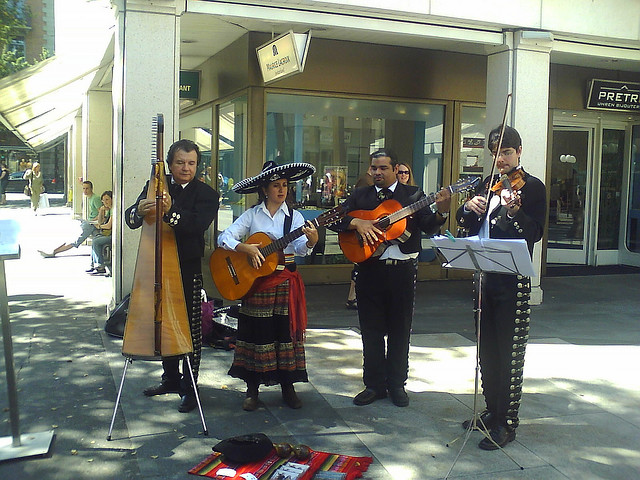
Mariachi band in Veracruz. (Not typical; no trumpets!) Photo by Roger at kultpavillon, Flickr
Then there’s the proud Jarocho (Veracruz native) with his beautiful voice who serenaded the cheapest restaurant we could find, as we ate in the company of three-quarters of the local police force.
On Friday evening we were in an even cheaper restaurant, sharing a single meal, figuring out if we could scrape by on 5000 pesos ($5 CDN) each per day because we had missed going to the bank before the weekend, when a shaky old man with a harp came in. He sang us this really cute song in which he asked the musical questions, “Do you like Mexico?” “Where are you from?” and “What are your names?” He incorporated our answers into the song — then demanded 1000 pesos.
You soon stop thinking in dollars and how cheap things are.
Mexican women in towns and cities are always well dressed, and sexily, with straight skirts or tight pants, tight belts, dress shoes often with very high heels, well groomed hair and makeup. They carry themselves “properly” and even the little girls often seem prim. I think it strikes me because they embody old-fashioned and “ladylike” values that we (or should I speak only for myself?) picked up from literature, teen magazines, and the culture around us, and our mothers, but may have examined and rejected, often in a reactionary manner. The paradox to me is that even in my relatively sloppy clothes I receive so much attention from Mexican men.
We spent two days at Catemaco Lake, a very pretty freshwater lake in the hilly Tuxtla region south of Veracruz. I was constantly reminded of Greece, as the town is quite touristy with many hotels and restaurants, a Greek-like combination of hills, water and music, and a similar level of infrastructure. In so many ways Mexico is like a developed country. The first class bus system is excellent, except when the air conditioning doesn’t work. The subway in Mexico City is as slick as Montreal’s, and designed for illiterates as well as readers. Telephones are common, unlike in Nigeria. Pay phones are free since the one peso coin became worthless, and the rate of inflation makes updating the phones not worthwhile. There are many newspapers of various political persuasions, with an apparently high degree of variety and independence. The pollution is worthy of the most industry-ridden country – it’s absolutely awful. Then for contrast, one sees the shanty towns on the outskirts of the city, or peasants living and toiling under deplorable conditions.
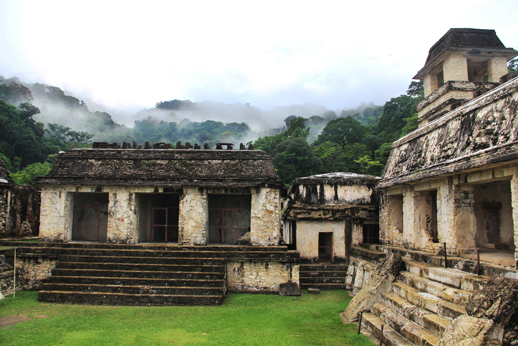
Palace at Palenque. Photo by Ricraider, Wikimedia Commons
Back to the tourist trail: we didn’t speak to another native English or French speaker for a week until we reached Palenque, a site of ruined pyramids amid magnificent rainforest-covered mountains whose shapes reflected those of the pyramids and spawned fantastic lava-formed waterfalls. By then, English had become a private language and it felt odd to speak it with outsiders. My French came out with great difficulty as I was immersed in Spanish.
When I was in Nigeria, we long-term CUSO volunteers, living in our host communities, developed a collective disdain for people who just passed through, gawking and snapping pictures. However, being a tourist among Mexican tourists in Veracruz somehow made it feel “OK”. There are magnificent sights worth seeing in Mexico, such as Palenque, the Anthropological Museum, Diego Rivera’s murals in the Palacio Nacional, and the Aztec temple ruins discovered six years ago in the main square of Mexico City.